Where to put a watermark on a photo
Put the mark in the centre if it has to survive every common crop: in our data it stays whole in all five crops (1:1, 4:5, 3:4, 9:16 and 16:9) for every photo shape we tested. A corner mark stays whole in at most one. On a landscape photo, top-centre or bottom-centre survives four.
Published . Drafted with AI assistance and checked against the sources linked on this page. How we write our guides.
Best place for a watermark: centre, edge or corner
The best place depends on one question: will the photo be cropped after you post it? Feeds and video thumbnails show a photo at a ratio of their own, and we assumed each crop is centred. We measured what five common centre crops keep of a photo, and where a mark placed in each of nine positions ends up.
In our data the centre is the only position that stays whole in all five crops, for every source ratio we tested. A corner mark stays whole in at most one of the five crops: none for a 3:2, 4:3 or 2:3 source photo, one for a 3:4 or 1:1 source photo. The table counts, for each position, how many of the five crops (1:1, 4:5, 3:4, 9:16 and 16:9) keep the whole mark.
| Position | 3:2 and 4:3 source photo | 2:3 source photo | 3:4 source photo | 1:1 source photo |
|---|---|---|---|---|
| Centre | 5 | 5 | 5 | 5 |
| Top-centre, bottom-centre | 4 | 1 | 2 | 4 |
| Middle-left, middle-right | 1 | 4 | 4 | 2 |
| Any corner | 0 | 0 | 1 | 1 |
The mark in these counts is a wordmark 20% of the image width wide and 3% of the width in from the edge. A square logo of the same width gave the same surviving positions.
How to place a watermark on photos so a crop keeps it
Two rules follow from the numbers. We suggest them as our advice, not as a platform rule.
- Place the mark on the short axis of the photo. On a landscape photo (3:2 or 4:3) the top-centre and bottom-centre positions stay whole in four of the five crops; only the 16:9 crop cuts them. On a portrait photo (2:3 or 3:4) the middle-left and middle-right positions stay whole in four of the five; only the 9:16 crop cuts them.
- If one crop matters most, use it. For the feed shapes alone (1:1, 4:5 and 3:4), the safe region of a 3:2 source photo is a centred strip 50% of the width and the full height, which keeps the top-centre, centre and bottom-centre marks. For a 2:3 source photo it is the full width and 67% of the height, which keeps middle-left, centre and middle-right.
In the photo watermark tool you can pick any of these positions and preview it before you save. For the width of the mark, see how big a watermark should be.
The area that survives every common crop
The region that every one of the five crops keeps is a centred box worth about 32% of the photo. On a 3:2 source photo it is 38% of the width and 84% of the height; on a 2:3 source photo it is 84% of the width and 38% of the height. For a 4:3 source photo it is 42% by 75%, for a 3:4 source photo 75% by 42% and for a 1:1 source photo 56% by 56%.
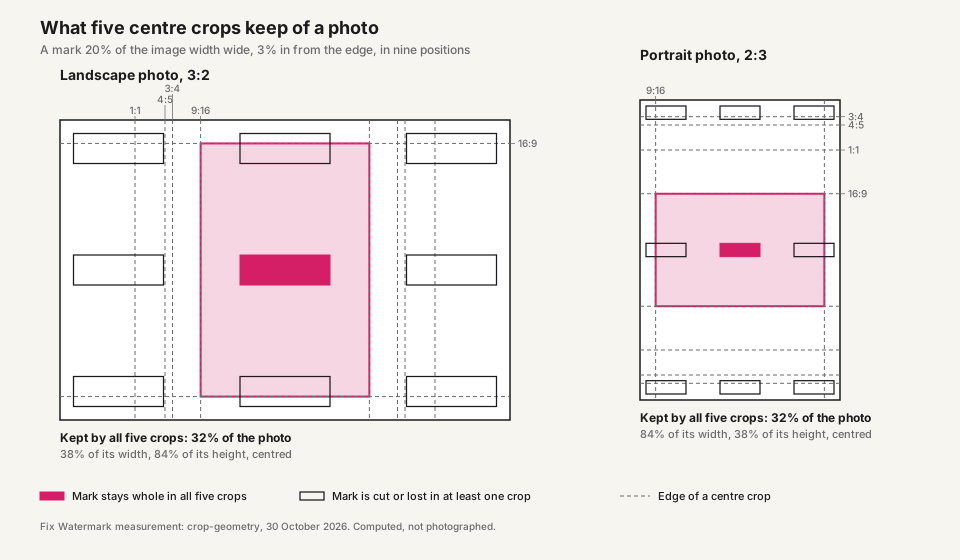
A 3:2 source photo keeps 67% of its width for a 1:1 crop, 53% for 4:5, 50% for 3:4 and 38% for 9:16; a 16:9 crop keeps all of the width and 84% of the height. A 2:3 source photo keeps all of its width and 67% of the height for a 1:1 crop, 83% for 4:5, 89% for 3:4 and 38% for 16:9; a 9:16 crop keeps 84% of the width.
Which crops these are, and whose
We chose the five crops from platform help pages, read on October 30, 2026.
- 1:1, 4:5 and 3:4. Shapes inside Instagram's range for feed photos. Instagram's help page says it keeps a photo at its original resolution
as long as the photo's aspect ratio is between 1.91:1 and 3:4
, and that a photo outside that rangewill be cropped to fit a supported ratio
(Instagram Help, image resolution). - 9:16. YouTube Shorts thumbnails: YouTube Help says
for Shorts, try to upload a thumbnail with an aspect ratio of 9:16
and gives 2160 by 3840 pixels (YouTube Help). - 16:9. YouTube video thumbnails: YouTube Help says to
try to upload a thumbnail with an aspect ratio of 16:9
(YouTube Help).
We make no claim about the shape of Instagram's profile grid today, because no current Instagram page we read documents it. For more on that platform, see watermarking photos for Instagram.
Tiled watermark: when to cover the whole photo
A tiled watermark repeats the mark across the photo in a grid or on a diagonal. We did not measure tiling, so this section is our reasoning, not data. A repeated mark has a copy in every part of the frame, so any crop of the photo still contains at least one tile.
The cost is the picture. A tiled mark sits over faces, text and fine detail, and it makes the photo less pleasant to look at. We suggest tiling only when the photo has a use where being seen clean does not matter, such as a proof sent to a client for approval. For a portfolio or a product page, we suggest one mark in the centre at low opacity, or one on the short axis as above. The watermark opacity guide has contrast numbers for choosing how faint the mark can be.
Keep faces and the product clear
The centre is also where the subject usually is, so a centre mark competes with it. Our crop data says where a mark survives; it does not know what is in your photo. These choices are ours:
- Look at the photo first and place the mark in the part of the surviving area that has the least detail, such as a plain wall, sky or table.
- Keep the mark off faces and off the edges and labels of a product. On a portrait photo, middle-left or middle-right may clear the subject while surviving four of the five crops.
- If a position that suits the photo is cut by one crop, accept that crop for that platform, or save a second version for it.
How we measured
We used source photos of ratio 3:2, 2:3, 4:3, 3:4 and 1:1, and centre crops to 1:1, 4:5, 9:16, 16:9 and 3:4. A mark 20% of the image width wide sat 3% of the width in from the edge, in nine positions: four corners, four edge midpoints and the centre. The main case is a 3:1 wordmark; a 1:1 logo is a second case.
All lengths are shares of the source width, computed with exact fractions. A centre crop to ratio t keeps the full height and a width of t over the source ratio when the source is wider than t; otherwise it keeps the full width and a height of the source ratio over t. A mark survives whole when its rectangle lies inside the kept rectangle, in part when some of its area does, and not at all when none does. No image was cropped or rendered.
We did not test crops that are not centred, marks of other sizes or insets, rotated or tiled marks, what an app's interface covers (captions and buttons), or the real profile grid.
Sources
Checked October 30, 2026.
Questions
- What is the best place for a watermark on a photo?
- If the photo may be cropped, the centre: in our data it is the only one of nine positions that stays whole in all five common crops. If you want it out of the way, use top-centre or bottom-centre on a landscape photo and middle-left or middle-right on a portrait photo, which each survive four of five.
- Will a corner watermark survive Instagram's crop?
- Not reliably. In our data a corner mark stays whole in at most one of the five crops we tested, and in none for a 3:2, 4:3 or 2:3 source photo. Instagram says it crops a photo whose shape is outside 1.91:1 to 3:4, and a crop always takes the edges first.
- How much of a photo survives every common crop?
- A centred box worth about 32% of the photo. On a 3:2 source photo that is 38% of the width and 84% of the height.
- Should I tile my watermark across the photo?
- We did not measure tiling. In our view it suits proofs, where the picture does not need to look clean; for a portfolio we suggest one mark placed to suit the photo.
- Does the position change if I post a vertical photo?
- Yes. The short axis flips: middle-left and middle-right survive four of five crops on a portrait photo, where top-centre and bottom-centre do on a landscape photo.